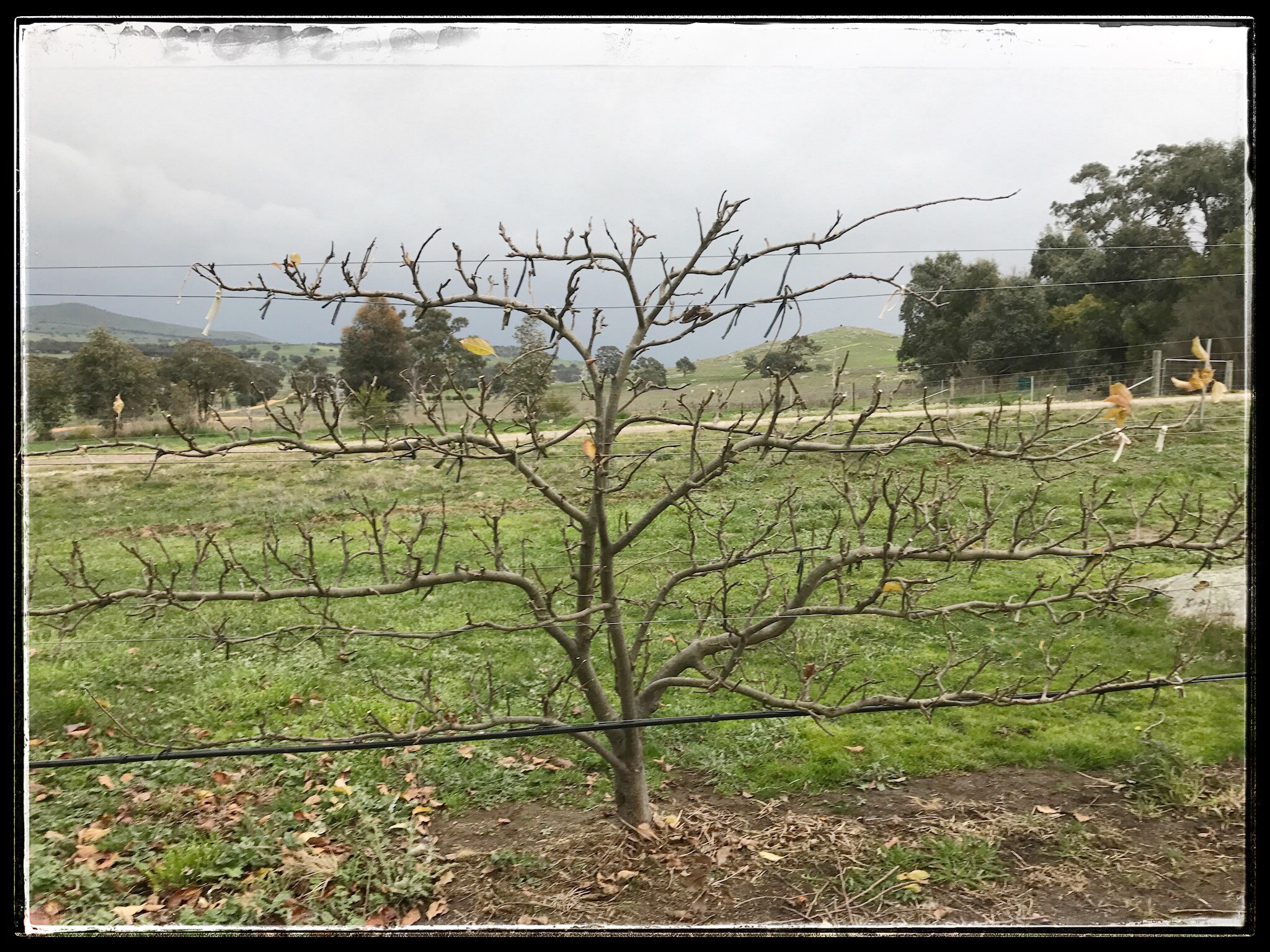
We have 22 fruit trees in our orchard. And they are all espaliered onto wires. The main reason we did this is so that the fruit is easy to access, and we can control how tall the trees get. It is also a great way to ensure lots of light gets into the tree, as shaded branches don’t fruit anywhere near as well. I’m a bit late with the pruning this year. Ideally I would prune in June (winter for us in the southern hemisphere) however this year it was well into July by the time I’d finished.

We have to net our trees over spring and summer, as otherwise our pesky sulphur-crested cockatoos and galahs get to the fruit long before we are ready to pick it! So firstly I have to snip off all the long growth that has grown up through the net, and then peel the net back away from the tree.
 Above you can see some cocky damage.
Next I stand back and have a good look at the tree. I assess which branches need training, and where I need to make cuts. The trees are quite mature now, and don’t need a lot of training, however occasionally there is a wayward branch that I feel needs tying down, or a tip of a branch that I’m trying to extend further along the wires.
Its important to know what type of branch each tree produces its fruit on, so for example most stone fruits, apricots, peaches, etc, fruit on one year old branches; whereas apples and pears fruit on branches that are at least two years old. You can tell a fruiting bud as it has 2 or 3 buds on the one node, as below.
 It’s important to leave some non- fruiting nodes as they will be next year’s bearers.
Also stone fruit are quite difficult to espalier horizontally, they much prefer a more fan shaped prune. Apples and pears – very easy horizontally.
Once I’ve had a good overall inspection of the tree, I start on the lower branches, and from the outside of the tree working inwards towards the trunk. Our espalier system consists of one wire down low, that also holds our watering system, and the three rows of two wires. So starting on that bottom wire, I first tie down the tip of that branch if I feel it needs it. Then I start snipping off the vertical growth leaving three or four buds.
 Above, you can easily see the lateral branches tied down over the years to the horizontal wires, then all the verticals growing up.

And a finished tree
Please don’t hesitate to drop me a line if you have any questions (or suggestions) on how I’m pruning my trees. Do you do it the same way?

No responses yet